
Does Your Cat Carrier Fit the Trip You’re Taking?

Expert verifiedSources and qualifications checked
Nora Bennett reviews clarity, structure and the writer’s voice. Adrian Cole reviews source support, qualifications and image attribution.
Reviewed November 14, 2026 for this version of the article.
Meet the Editor Voices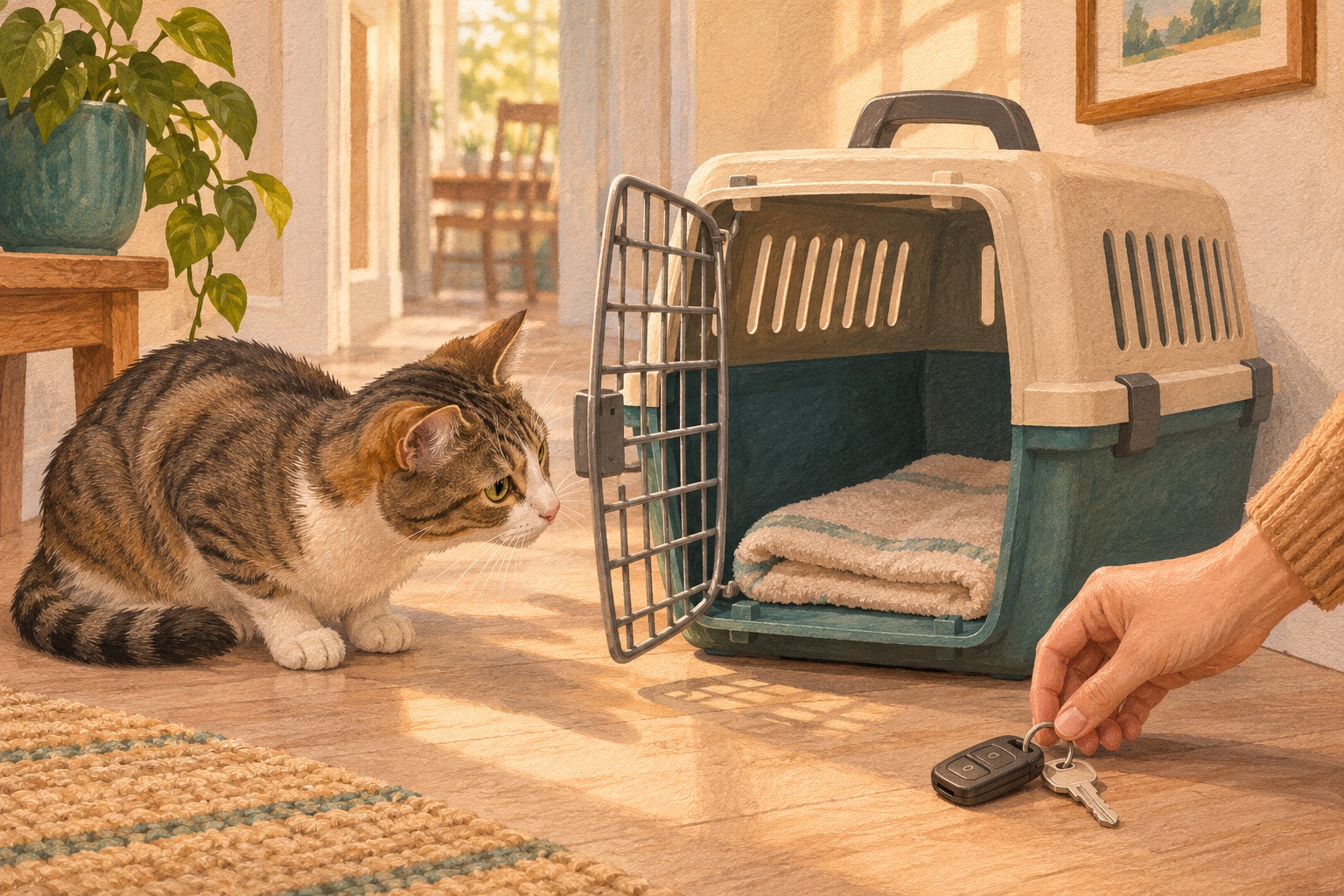
Start with the ride, not the carrier
A local car ride is the simplest version of the trip, so decide that one first. Picture the sequence: the carrier comes off its shelf, sits on the floor, takes the cat, gets lifted, passes through a doorway, and ends up in a vehicle. Each step has its own demand, and a carrier that suits one step can make the next harder. A roomy hard shell may be easy for the cat to enter and awkward for you to carry through a narrow hall.
If the trip is a short drive and the carrier gets the cat in, holds closed, and can be secured in the car, it passes the main test. Keep it. Many households already own a carrier that does this, and replacing it for a feature you will not use at the destination adds cost without improving the route.
Check the door before anything else
Once the carrier is on the floor, look at the opening from the cat's side. Entry height matters more than the manufacturer's overall size, because a cat steps over a lip, ducks under a top edge, and turns around in whatever space is left. A door that sits high on the front may suit one cat and frustrate another, so judge it against yours.
Then work the latch yourself with the carrier loaded as it would be on the day, which means one hand free at most. A door that swings shut on its own, or a latch that needs two hands, shifts effort onto the moment when you are also holding a cat. If the door works smoothly while you are crouched on the floor, test it again from standing, since that is where you will close it before lifting. A door you can only manage in ideal conditions is a reason to look at a different carrier or a different loading spot.
Handles, fasteners and the carry
Next, lift the empty carrier by its handle and walk it to the door. Note the empty weight by feel, then add the cat in your mind, because the carry is the two together. A load rating from the manufacturer tells you what the object is built to hold; it does not tell you whether you can hold it comfortably across a landing or down a flight of stairs. If your route includes steps, a carrier with wheels may still need to be lifted at every one, which can leave you with the heavier object in the hardest place.
Inspect every fastener and the handle attachment points. Look for cracks, loose clips, frayed stitching, and any latch that no longer clicks. A carrier that has sat in storage can fail at exactly the part you will rely on. If you cannot lift the loaded carrier with a steady grip, a shoulder strap, a different handle position, or a helper at the stairs is a better answer than pushing through. Caregiver capacity is an ordinary buying criterion, not a footnote.
Usable interior and ventilation
Measure the usable interior, not the shell. Padding, liners, and molded ribs can cut the space your cat actually has, and two carriers with the same outside size can offer different room inside. Look at whether your cat can stand, turn, and lie down without pressing on the walls.
Check the ventilation openings with the carrier closed and sitting where it will ride. A carrier pressed against a seat back or a wall can have its openings partly covered, so make sure air still has somewhere to move. A familiar blanket or toy may help the cat settle, according to the American Veterinary Medical Association, but anything you add takes up interior space, so put it in during the rehearsal and see what it does to the room left over.
Rehearse the trip before the trip
The most useful check costs only time. The American Veterinary Medical Association advises letting a pet get used to the carrier and to short car trips before a longer journey, and that gives you a natural plan. Leave the carrier out with the door open for a stretch so it becomes part of the room. Then load the cat, carry it along your real route, secure it in the car, drive a short loop, and bring it back inside.
Rehearsal can reveal a problem you would miss on the floor at home. Maybe the carry went smoothly until you reached the stairs. Maybe the door was easy to close in the hall but awkward once the carrier was in the car. Follow the carrier and vehicle instructions to secure the carrier before you drive, and keep it closed in the car. Once you’re home, note where the cat hesitated and where you had to change your grip. Those are the parts to simplify before the real trip.
When the trip involves an airline
An airline trip needs two separate questions, because the carrier and the provider each have their own answer. First: does this carrier fit the airline's stated requirements for this trip? Second: does the airline accept this cat on this flight in the way you plan to bring it? A carrier accepted on one trip is not automatically accepted on a different trip, and the American Veterinary Medical Association recommends checking the airline's exact requirements before you book.
Read the airline’s current pet travel page for the exact trip. When it asks for outside dimensions, measure the outside of the carrier. Use the inside measurements to check the room your cat actually has. If the policy does not answer your question, ask the airline before booking. Keep the airline’s answer with the itinerary so you can check it again if the flight changes.
Choose by space and effort
Keep the carrier you own if your cat has room inside, the door and latch work in your hands, the fasteners are sound, and you can carry it loaded over your actual route. Replace it, or change the route, if one of those fails and no small fix addresses it. For a local car ride, that decision rests on your own rehearsal. For a flight, the carrier is only half of it, and the airline's current answer for your trip stays open until you have it.
If the door is the sticking point, try the same carrier in a spot that gives you room to crouch beside it. Rehearse with the person who’ll be carrying it. Someone who can lift it from the hallway floor may prefer to hand it off at the stairs. You’ll know which change to make before you have an appointment to get to.
Related stories



Caleb Morgan
Caleb covers products that help pets move through the day, including carriers, ramps, steps, travel beds, and grooming tools. His comparisons focus on dimensions, access, storage, cleaning, and the effort required from the person using the product. He is especially interested in how those needs change with an older pet. His household includes his daughter, Jasper, a senior mixed-breed dog, and Nell, a rescue cat. He looks for the details a product page can leave until last: whether a carrier fits the space, a ramp stores sensibly, or a bed cover comes off without a struggle.