
An Everyday Dog Walking Kit With Gear You Already Own

Expert verifiedSources and qualifications checked
Nora Bennett reviews clarity, structure and the writer’s voice. Adrian Cole reviews source support, qualifications and image attribution.
Reviewed November 14, 2026 for this version of the article.
Meet the Editor Voices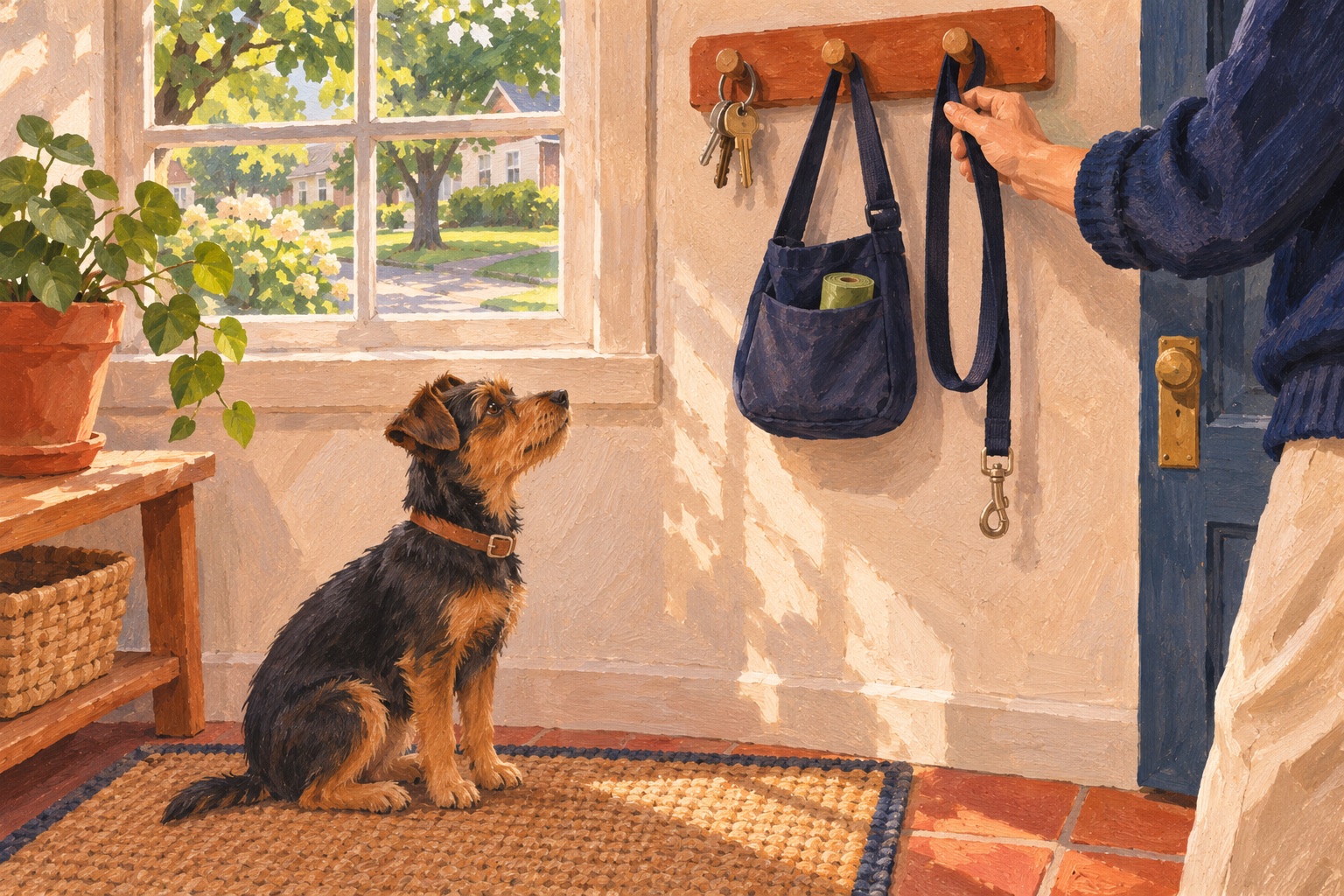
Hang the leash and keys together
Start by choosing one hook at a height an adult reaches without stretching. Clip the leash handle or loop onto it, then put the keys on the same hook so they cannot wander off into a coat pocket. The point is that one motion collects both. If the keys live in a bowl across the room, the walk starts with a search, and a search is where the routine breaks.
Check the hook before you commit. Lift the leash off and clip it back with one hand, as you would while holding a dog's attention with the other. If you have to use two hands or squint at the clip, move the hook or turn the leash around so the clip faces you. A large dog who leans into the door and a small one who dances at your ankles both make one-handed handling the realistic standard.
Decide now what stays inside: treat pouches, spare collars, towels and anything that needs sorting. The door hook holds only what every single walk requires, and a crowded hook is slower than a bare one.
Keep two waste bags within reach
Start with one bag for the usual stop and one spare. The CDC dog care guidance says to pick up dog waste and dispose of it properly. Keep both bags together on the hook so you always know where the spare is.
The second bag is there for the ordinary reasons. A bag can tear, a dog can go twice, and a walk can stretch longer than you planned. Carrying one bag means betting the whole outing on a single attempt, and carrying two costs you almost nothing in weight or pocket space.
Test the reach honestly. Stand at the door with your coat half on and take the bags without looking. If they sit under the leash or behind the keys, swap them. You are designing for a distracted adult, not a rested one, and that adult deserves a setup that works anyway.
Pick a route and plan the stops
A route you can describe in one sentence is easier to hand off. Say your block loop runs out the front door, left to the corner, around the small green strip, and back along the other side of the street. That loop has a natural place to use a bag near the strip and a bin near the corner, and anyone can follow it from the description alone.
Think about where disposal happens before you leave. The CDC dog care guidance asks for proper disposal, and the right place depends on your street, so note the bin your loop passes and what to do if it is full. If there is no bin on the route, carry the sealed bag until you reach one at home. Choose that carrying habit ahead of time, because deciding at the curb with a leash in one hand is when people shortcut.
Make two versions of a route your dog already knows: one that turns at the first corner and one that carries on around the park. Tell the next walker where the two split. If your dog usually balks at a particular crossing or pauses at one gate, tell them that too. Familiar details make the handoff easier than a mileage estimate.
Refill the bags when the hook runs low
When you get back, check the bags on the hook before you put the leash away. If there’s only one left, add a spare. If there are none, add two for the next outing. That couples the refill to something you already do every day.
Keep the supply in one spot near the door but out of the way, such as a drawer or a shelf within a step of the hook. Whatever container you already have works. If refilling takes a trip upstairs, the rule will fail by the end of the week, so shorten the trip until it is a reach.
There is one more small decision. Leave the hook empty of anything that is not a bag, the leash or the keys. When a bag count is easy to see, an adult can glance at it on the way out and know whether the walk is stocked.
Wash up after the walk
Handwashing belongs at the end of the loop. The CDC dog care guidance says to wash your hands after handling waste, even if a bag was used. A bag lowers the mess but does not replace the washing, so build it into the return.
Make the sink easy to reach from the door. If the nearest sink is far away, the step becomes optional in practice, so choose the closest one and keep soap there. Hang the leash back on its hook after you wash, not before, so the hook stays clean and the order of events is fixed: walk, bag, wash, hang.
If the leash handle took a splash or got damp, let it dry where it hangs and check it at the next walk. You do not need to turn this into a cleaning project. A quick look is enough, and the dry-off happens while the household carries on.
Hand the walk to someone else
A handoff works when the routine is on the wall, not in your head. Tell the next person three things: where the hook is, which loop to take, and where the bag supply lives. If they can find those without asking, the setup has done its job.
Walk the loop with them once if you can, and let them clip the leash and take the bags themselves. Watching an adult handle it is worth more than a paragraph of instructions, and it shows you whether the hook height and bag spot suit their reach. A partner or older relative may need the hook lower or the bags in a different place, and that is a fix, not a flaw.
Children can help with the routine, such as pointing out the bag count or hanging things back. Adults handle the dog, the leash and the waste.
Pack more only when the trip needs it
Everyday walks need the leash, keys and two bags. Longer outings are different. The CDC pet travel guidance says to pack a leash, waste bags and water when you travel, and extra walk gear can depend on where you are going and what is available on the route. Treat that as a trip decision, not a daily one.
Before a longer outing, look at the route and ask what it offers. If there is nowhere to refill water or dispose of a bag, carry more and plan for it. If the route passes bins and a tap, you can carry less. Keep the extras in a bag in a closet, so the door hook stays lean.
That is the split worth keeping. The hook holds the walk you take every day, and everything else goes home with the trip.
Related stories
Lena Ortiz
Lena covers the gear dogs use every day: harnesses, leashes, beds, bowls, and the supplies that collect by the front door. Her comparisons focus on fit, adjustment, cleaning, and value across different dog sizes. She looks closely at which features make a busy routine easier and which simply add bulk or expense.