
How to Clean a Cat Water Fountain

Expert verifiedSources and qualifications checked
Nora Bennett reviews clarity, structure and the writer’s voice. Adrian Cole reviews source support, qualifications and image attribution.
Reviewed November 14, 2026 for this version of the article.
Meet the Editor Voices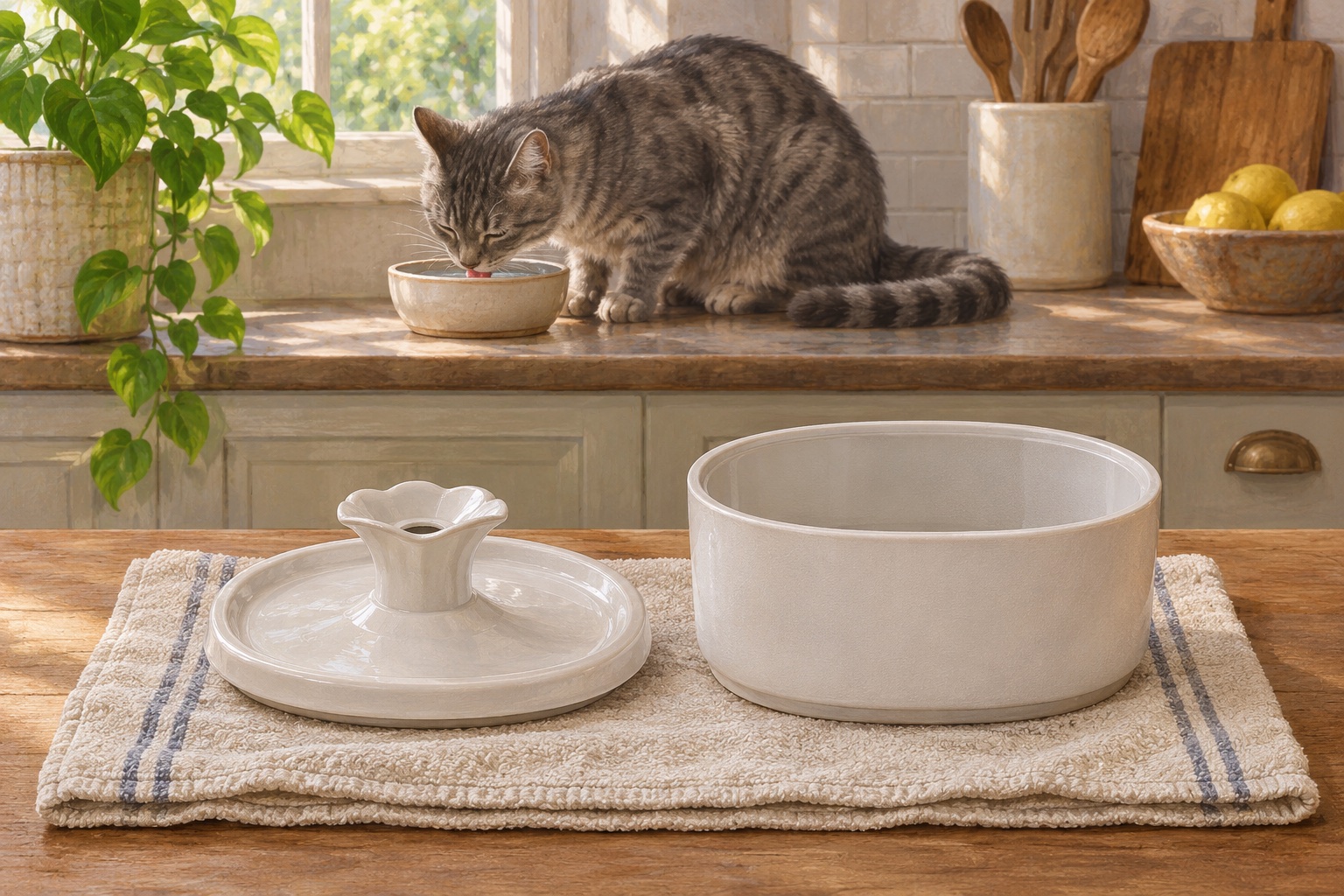
Put out a water bowl first
Start with the fallback, because it sets the pace for everything else. Before you lift anything out of the fountain, put a clean water bowl where your cat can reach it. The fountain's job is keeping water available, and while it sits in pieces on the counter, a plain bowl does that job with no parts and no dependencies.
This also removes the pressure to hurry. If a part needs to soak, or a filter has to be ordered before you can finish, nobody is waiting on the fountain. Leave the bowl out until the fountain is back together and working the way your manual describes, and keep it nearby afterward in case you need it again.
Place it away from the work area, and fill it as you normally would. That way the cleaning session is only a change in where the water comes from, and nothing else about the day shifts.
Find the manual for your exact model
Fountains from one brand can be built differently, and the cleaning steps follow the build. Look for the model name on the base or underside of the unit, then find the matching manual. If the paper copy is gone, the manufacturer's support pages are the usual place to look. Consult your exact model manual before you start, and treat the rest of this piece as a way of reading it, not a replacement for it.
Manufacturer cleaning instructions may treat the tray and reservoir as one job and the pump and filter as separate jobs. Put the manual where you can see the parts diagram as you work. Find out what comes apart for a wash, what needs a separate step and which parts must stay dry. If you remember a quicker way from an old fountain, check whether the same pieces come apart before trying it.
If you cannot find a manual, note the brand, model and any markings you can read on the unit, and ask the manufacturer's support. That is better than cleaning by analogy, and the answer is easy to keep with the fountain afterward.
Wash the basin and reservoir
Unplug the fountain before you take anything apart. The basin, tray or reservoir is the visible part of the job. Empty it, remove the pieces the manual says come out, and look at where water sits and where it splashes. Cleaning here usually means a soft cloth or sponge and the washing method your manual names. If the manual says a part is dishwasher safe, or says it is not, that line outranks habit.
Cleaning and disinfecting are different steps in pet-supply advice. Cleaning removes visible residue; disinfecting is separate and has its own products and conditions. Ask your manual whether it calls for anything beyond washing, and which products it permits on which material. Plastic, ceramic and stainless steel parts can each come with their own limits, so follow the manual and any care labels on the parts.
Rinse the washable parts, then follow the manual’s drying directions. Lay the pieces that come off on a clean towel while you work. Leave electrical parts where the manual says they should stay, and keep the ports it identifies dry.
Check the pump diagram
Start with the pump diagram. It shows you which pieces the maker expects you to remove and which openings need attention. That is why this is the section where you should stay closest to the printed steps. Follow the manual's instructions for powering down, for removing the pump, and for what may and may not get wet. Do not improvise an electrical step because it seems obvious.
The motor cavity is a separate job from the basin, and a cloth that has just done the basin should not automatically move on to the pump area. Check whether your manual names a brush, a kit or a particular method for the pump housing, and use only what it names.
When you reassemble, look at how the manual shows the pump seated. If the pump sounds different or you see a change in the flow, check the troubleshooting section for your model. If it still misbehaves after a careful second try, that is a question for the manufacturer, not a reason to open anything the manual does not open.
Read the instructions for your filter
The filter is the consumable in this arrangement, and your manual decides what you do with it. Some are rinsed, some are replaced on a schedule, and some are replaced when you judge them spent. Read the line for your model rather than assuming the pattern, and note which way the filter faces if the manual shows an orientation.
If your fountain has a replaceable filter, write down the exact part name and the interval published in the manual. Knowing both before the day you need one keeps the water bowl from quietly becoming the permanent arrangement. Write the change date somewhere you will see it.
If your manual does not give an interval, treat that as an open question for the manufacturer's support line. Do not substitute a number from another fountain.
If you're replacing the filter, keep the old filter out of the fountain while you work, and set the new one aside until the basin and pump are done. Handling it last keeps the order simple.
Set a routine you can actually keep
The CDC guidance on cleaning pet supplies covers water bowls, including the bowl you set out while you work. Use your fountain’s manual for the cleaning schedule of its separate parts. If it gives one interval for an ordinary wash and another for taking the fountain apart, write down both.
A routine that survives a busy week is built from the same three jobs. The basin and reservoir get the regular wash. The pump area gets its separate, manual-directed attention. The filter follows its own calendar. Writing the three down on a card by the fountain, with the manual's intervals, means you are not rereading the whole document each time.
Before you remove the bowl, fill the fountain to the level the manual specifies, set it up as the manual shows, and watch that water is moving as described. Only then take the fallback away. If something does not match the manual, leave the bowl out and sort out that one part first. The goal is a fountain you service by the book, with a plain bowl ready for the day it is not available.
Related stories

Theo Grant
Theo covers the electronics entering pet homes: automatic feeders, water fountains, cameras, and connected accessories. His specialty is comparing the whole ownership experience, including setup, cleaning, replacement parts, subscriptions, and what happens when the connection drops. He pays close attention to which advertised features require a paid plan. His household includes his partner, Scout, a rescue dog, and Pixel, a shorthair cat. The question running through his coverage is straightforward: does the technology remove a chore, or give the owner another device to manage?